Main

May 04, 2008

Octamaze

Back in 1994, some folks decided it would be a cool idea to give a special 80th birthday present to Martin Gardner, long-time author of the very popular and significant Mathematical Games column in Scientific American magazine, as well as many books of mathematical puzzles and articles.

What better way to mark the occasion, they thought, than to bring together a lot of people who had enjoyed, and been influenced by, Martin's work? So they invited a bunch of people from the fields nearest to Martin's heart, from mathematics, puzzling, and stage magic, to come to Atlanta for the "Gathering for Gardner": several days of talks, performances, and exhibitions in celebration of Martin's 80th birthday. That first Gathering was such a huge success that the organizers decided to keep doing it and, every two years since then, there's been a Gathering.

I've known about the Gathering for some time now, through contacts at the International Puzzle Party, but I was pleased to be invited for the first time this year, for "Gathering for Gardner 8", or "G4G8". Similar to the Puzzle Exchange every year at IPP, the organizers of the Gathering ask that everyone provide a gift of some sort for all of the other participants. Many people fulfill this obligation by giving a talk and writing up a short article for the conference proceedings book, but many others bring puzzles, magic tricks, or other entertaining objects.

You know, of course, what I did, right?

Every Gathering for Gardner has a theme; I think you may be able to guess what all of the previous themes were when I tell you that this year's was "8, or the crazy lazy 8 (infinity)". I wanted to bring a new puzzle design that would strongly incorporate the theme, of course, but I also wanted to continue down the path I'd forged with my Ooo Tray puzzle last year. I wanted to design another multi-stage puzzle, with each solving stage revealing clues to the next stage, culminating in a "final answer" that was somehow satisfying.

I'd been idly thinking about three-dimensional edge-matching puzzles for a while (What? Don't try to tell me you don't think about such things, too.), and I'd wondered if it would work to make a polyhedron where the sides fit together with tabs and slots. With a theme like "8", this was a perfect (some might say Platonic) opportunity!

A little software work and many design iterations later, Octamaze was born. There are at least four stages in solving this puzzle, providing a good hour or two of "play time". If you buy a copy of Octamaze and get stuck, I've created a sequence of web pages giving a progression of hints for solving it. (Don't worry: clicking on that link won't immediately reveal any spoilers. If you keep clicking on the links at the bottom of each page, though, you'll eventually see all of Octamaze's secrets, so be careful.)

September 02, 2007

Six Tabbed Planks

I originally blogged about this puzzle a couple of years ago, shortly after I got my first copy of it, six years in the making. A few days after that, I got email from my friend George Miller, telling me that he'd laser-cut his own copy and liked it a lot. He showed that copy to long-time IPP attendee Stan Isaacs, who asked me for permission to use it in the IPP 26 Exchange, in Boston. At the time, I had a different puzzle in mind for my own exchange gift, so I agreed. Unfortunately, that other idea fell through (sometimes that happens with puzzle designs), so I ended up not exchanging that year. Instead, I was Stan's exchange assistant, which was fun in its own way.

The version that Stan exchanged was somewhat different from my original copy: he and George reshaped the pieces from rectangles to half circles, making the completed puzzle into a sphere instead of a cube; they called it the "Fan-Way Park Ball", following the Bostonian theme. They also used laser-cut maple instead of plastic and reduced the size to about 1-5/8 inches. It was cute in its own way, and I was happy to see the puzzle exchanged, but I still preferred the clear Lucite look of my original version; it looks a bit more stylish sitting on your desk.

I'm now happy to announce that I can offer copies of my version for sale here. The puzzle is shipped disassembled, flat, and putting it together provides a very satisfying but accessible solving experience.


August 17, 2007

The Ooo Tray

Every year, a group of volunteers puts on a one-day puzzle event for Microsoft's summer interns here on the Redmond campus called Intern Puzzleday. It's kind of a scaled-down version of the more well-known (and ambitious) Microsoft Puzzlehunt events. Although Puzzlehunt traditionally begins at about 10am on Saturday and continues straight through to dinner time on Sunday, Intern Puzzleday is a kinder, gentler one-day affair, almost exactly 24 hours shorter than Puzzlehunt.

This year, I had the great fun of joining the team of volunteers putting on Puzzleday 2007, and I designed or co-designed five different puzzles for the event, three of which we finally used on the day itself. Perhaps I'll write a fuller description of the event later, but for now I'll just show one of the puzzles I designed for it.

Traditionally, Puzzlehunt and Puzzleday puzzles are designed to have a short, one- or two-word answer that solvers can type into email or a web page to prove that they've finished. All of those answers are later used in one or more layers of "meta-puzzles" leading eventually to a final "hunt" somewhere on campus for an artifact specific to that hunt's theme.

I wanted to find some way to incorporate a mechanical puzzle into this domain that's typically dominated by paper-and-pencil or on-site-event puzzles. To do so, I started with the tray and piece design from my "Perkinson Guest Bathroom Tile" puzzle and laser-engraved some additional information on both. The result is, I think, something new in the world of mechanical puzzles: a puzzle with an answer, not just a solution. In this case, the answer is just four letters long, and finding it takes you through a multi-layer solving experience; guidance for the first layer is etched right onto the tray ("Place all twelve pieces flat in the tray"), and solving each layer reveals more guidance on how to attack the next one. There are a total of three or four layers to this seemingly simple puzzle, depending on how you count. During Puzzleday, the Ooo Tray was solved by all 28 teams of interns, and it was the first puzzle that many teams worked on.

Update:
The new edition of this puzzle is finally available, in beautiful, high-contrast black-on-yellow!


Easter Island Dominoes

Flush with the successful design of the "Perkinson Guest Bathroom Tile" puzzle, the obvious next step was to consider dominoes instead of trominoes. This time, I allowed the pieces to be flipped over, and I also counted pieces whose two tiles had their tilted edges at right angles to each other. This leads to a complete set with 13 members, some of which are slightly strange looking, and one of which (with the two tilted edges joined together) is a quite boring perfect rectangle.

Leaving out the boring rectangle, we get twelve roughly one-by-two-unit dominoes; the obvious tray shape is a six-by-four-unit rectangle. Can the (nearly) complete set fill that tray? Sadly, my packing program said no, and this time it also didn't work to change the top and bottom edges into the angular "sine wave" pattern from the bathroom-tile puzzle. I had my local laser cutter, Joe Pelonio, make me up a set of the pieces anyway, so that I could play with them and try to get a feeling about why the rectangular tiling wouldn't work. The first thing I noticed when I got the pieces in my hands was that one of them looked a lot like the profile of one of the famous "moai" heads from Easter Island; thus the eventual name of the puzzle.

When I presented Easter Island Dominoes at the 2007 IPP Exchange in Australia, I told the following story:

It's not well known (especially to archaeologists), but many, many sets of these 12 pieces have been discovered in excavations on Easter Island. Never, though, have they come across a copy of that elusive 13th piece, the perfect rectangle. From this, we can infer that the ancient Easter Island culture, now long lost to us, did not approve of straight lines and perfect rectangles. Being a culturally sensitive fellow, I've created a tray that has one tilted tile edge exposed on each edge of the tray, thereby avoiding violating the islanders' taboos.

Your first challenge in solving this puzzle is simply to lay all twelve pieces flat in the tray; there are 250 ways to do that, and it's not very difficult if you just have a bit of patience. You'll find, though, that almost every such packing has at least one blemish (as least from the point of view of ancient Easter Island culture): there will either be (a) a straight-line crack all the way across or down the puzzle, or (b) a subset of the pieces that form a perfect rectangle or square, or (c) both!

There are just 83 ways to pack the pieces without a straight-line crack, and only six ways to do so without forming a perfect square or rectangle. Your real challenge is to find one of merely three solutions that have neither "blemish". That'll take you a little bit longer to achieve, I think.

The "Perkinson Guest Bathroom Tile" Puzzle

A week before Thanksgiving, 2006, Kathleen and I drove down to Portland for the weekend, to see some dear friends who'd driven up that far from the Bay Area, and to attend a games party being thrown in their honor (or at least using them as an excuse) by Dave and Diane Perkinson. Dave and Diane are consummate hosts, and they'd invited us to stay in the guest room of their wonderful Craftsman-style house. The bathroom adjoining the guest room still has the great original tile, consisting of squares that have had one of their edges tilted, half one way and half the other. The tiles are laid in straight rows with the tilt of the edges alternating back and forth across the floor, making a kind of angular sine-wave pattern.

At some point as I was sitting in the bathroom, contemplating the world around me, I started to wonder how many ways there were to select three adjacent tiles from the floor in an L shape. (Now, their floor had the sine-wave lines from one row out of phase with those from the next row, but I allowed for both in-phase and out-of-phase patterns in my wondering.) Assuming that, like the real tiles, you couldn't flip a piece over to get its mirror image, I was pleased to discover that there are exactly twelve possibilities. Twelve pieces, times 3 tiles per piece, makes 36, a perfect square. This therefore led immediately to the question of whether or not a complete set of the pieces could be assembled to fill a six-by-six square. I resolved to find out as soon as I returned home, using my packing-puzzle design program.

Once I'd enhanced the software to support pieces that can't be flipped over, I was saddened to discover that the perfect six-by-six square is not, in fact, solvable. Happily, though, a complete set of pieces will nicely fill a variant of the square that has in-phase sine-wave lines at top and bottom. There are two distinct solutions, plus their mirror images. The "Perkinson Guest Bathroom Tile" puzzle is non-trivial to solve, but not wildly difficult either.


Sleazier

In the fall of 2004, I was playing around with a deceptively simple little tray puzzle designed by Stewart Coffin and called Four Sleazy Pieces. The eponymous pieces are polyominoes with between five and seven squares each, and the tray is a perfect square whose size is not an integral number of units; it's about 5.8 units on a side. I won't spoil Coffin's fine puzzle here, but suffice to say that, at the time, I hadn't solved it very recently so I'd temporarily forgotten just how "sleazy" the solution is.

While failing to solve it, I stumbled across an interesting property of such a puzzle, and I was excited to note that what I'd found was probably a good psychological "blind spot". These blind spots usually take the form of an assumption most people make that's so "obvious" that it's never questioned, even though it isn't in fact true. Armed with such a blind spot, you can often create a puzzle to exploit it, a puzzle whose solution violates that implicit assumption. That kind of a puzzle has a very pleasant "ah-ha" feeling to it; once you've solved it, you can't figure out how it could possibly have taken you so long.

My resulting puzzle, Sleazier, has that property, and I'm inordinately pleased with it: I think that it's probably the best puzzle I've yet designed. I presented it in the 2005 IPP Exchange, in Helsinki, and it's gotten great feedback in the years since then.

Like Coffin's puzzle, Sleazier has four polyomino pieces ranging from five to seven squares each, and a square tray of a suspiciously odd size; your goal is simply to fit all four pieces flat in the tray. I won't say why, here, but when you compare the "trick" of my puzzle to that of Coffin's, mine definitely deserves its name.


The Devil's Half Doven

In my very first IPP Exchange, in 2000, I presented a puzzle designed by Bill Darrah, called Raft 5. It consisted of 10 sticks, each with a dovetail notch cut across it and a matching dovetail tab glued on along it. There were five different positions on the stick where a notch or tab could be located, for a total of 10 different pieces, and the puzzle contained one of each. Somewhat surprisingly, it's actually possible to assemble these 10 pieces in a raft-like arrangement, with five sticks going one way laid across five going at a right angle.

Raft 5 is a good puzzle, and for the 2003 Exchange in Chicago, I decided to take inspiration from it. The raft is essentially two dimensional, and I wanted to somehow extend the idea into 3-D. To keep the number of possible pieces down, I made my sticks shorter, with only three positions where a notch or tab could be placed, but I also made the sticks square in cross-section (as opposed to rectangular, as in the raft). This allowed tabs and notches to appear on different sides of the stick, even at right angles to one another.

If you leave out the cases where a notch and tab appear in the same position along the stick (unless they're on opposite sides of the stick), then you get a total of 14 possible pieces. That seemed like too many for a good puzzle, so I picked just half of them; I was perversely tickled by the idea of using seven pieces in an interlocking puzzle, instead of the traditional six. Of course, seven pieces can't make a very symmetric shape, but I made a virtue of that, and designed the puzzle so that the final shape isn't particularly important. Instead, the goal is simply to arrange the pieces so that every piece's tab is inserted into some other piece's notch; that forms the pieces into a kind of folded-up loop, each inserted into the next, like a snake eating its own tail.

There are four solutions to the puzzle, two of which have the fun property that the resulting assembly will balance nicely on the end of one of the sticks. Those two solutions look a bit like a figure standing on one foot, which I like quite a lot; at some point, I want to make a very large set of the pieces to use as a bit of artwork for our yard.


The Grand Vizier: A Penrose tiling puzzle

Grand Vizier piece

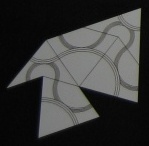
For the 2002 puzzle party in Antwerp, I wanted to design something that would lead people to explore the strange world of Penrose's non-periodic kite-and-dart tiles. Some years earlier, someone else had already exchanged a Penrose-based puzzle; that one was just a set of kites and darts that had been distorted a bit to resemble two kinds of birds (and to enforce the normal edge-matching rules). The goal had been simply to fit them together to make the classic regular decagon that crops up every you look in any tiling.

For my own puzzle, I wanted to challenge you to do more than simply learn how to tile the pieces; I wanted it to be a real puzzle. I played around with a Penrose tiling applet for a while and came up with an outline that looked, to me anyway, a lot like the head of a man wearing a turban. That shape required 76 tiles to make, so I broke it up into a set of 16 multi-tile pieces, each containing between 3 and 5 tiles. I then laser cut and etched those pieces with Conway's beautiful curves that show where the legal edge matches are. The resulting puzzle has a unique solution and is fairly difficult.

To make it a bit easier, I added a little removable panel that reveals where some of the tile boundaries are (and that shows why I thought the shape looked like a Grand Vizier). I also included in the package a "little bit bigger hint" that shows where all of the tile boundaries are (but not the piece boundaries, of course).

Finally, I discovered that a subset of pieces I'd chosen could be assembled to form that same classic decagon I mentioned above, so I made the puzzle tray two sided, with the outline of the Grand Vizier on the front and the outline of the decagon on the back. Oddly enough, even though I don't tell you which subset of the pieces you have to use in filling the decagon tray, that side is definitely easier than the front.


August 10, 2007

Hinomaru: The Japanese Flag Puzzle

In 2001, the 21st annual International Puzzle Party was held in Tokyo, and I decided to honor the hosts with a puzzle based on the simple, elegant design of the Japanese flag, also known as Hinomaru (literally, "the circle of the sun"). To start, I drew the flag's design on a 6-by-4 rectangle and then broke it up into twelve 1-by-2 dominoes. Then, to make things tricky, I also colored the backs of all of the dominoes in ways that make them look like potential fronts. Thus, all of the dominoes are double-sided, and it's not at all obvious which side is the front! Add to this the high degree of symmetry in the flag design, which makes the piece placements even more ambiguous, and you have a very difficult puzzle.

(At the 2007 IPP in Australia, six years later, someone came up to me during the Exchange and said, "I spent a long, long time solving that flag puzzle of yours." He then handed me his Exchange puzzle. "This," he said, "is my revenge!" Needless to say, I haven't solved his puzzle yet...)

The Hinomaru puzzle has a unique solution (up to swapping pieces with the same face-up design), and that solution leaves only the front face looking like the flag; the backs of the pieces look entirely random when solved (no helpful hints there!).

I also have an all-paper version of the puzzle, consisting just of the 12 double-sided cards that are sandwiched inside clear acrylic in the version above. This version doesn't come with a tray, just the cards wrapped up in a simple origami envelope.


Shopping Cart