Main

August 21, 2010

The Calibron 12-Block Puzzle

In March of 1931, a man named Theodore Edison, younger son of the famous inventor Thomas Alva Edison, filed articles of incorporation for a company named Calibron Products in West Orange, New Jersey. The company's first product was a special kind of graph paper, designed to make it easier to create perspective drawings.

But in December of the next year, the company filed for a copyright on "The Calibron 12-Block Puzzle". An advertisement for the puzzle appeared a few years later, in the January 1935 issue of Popular Science magazine.

The instructions for the puzzle read, in part, "The problem is to arrange the twelve blocks to form a single large rectangle. Any rectangle will do, provided that all twelve blocks are used... We guarantee that there is a straightforward, accurate solution of this puzzle in a single plane, and without recourse to any kind of trick... However, in spite of the enormous number of possibilities, there appears to be only one basic arrangement which satisfies the above conditions... We once offered $25 for the first solution of this problem and distributed hundreds of puzzles at that time, - but recieved almost no correct arrangements! We should like to hear from you if you succeed in making the rectangle unaided."

Not very many people have copies of the original Calibron 12-Block Puzzle, and that bothered a good customer of mine, who wrote me earlier this year asking for advice on how to get a few copies of the puzzle made. I decided to make the copies for him myself, and once the first prototype came off the laser cutter, I decided that it was quite an intriguing design, and that I'd like to make it more widely available again.

The twelve rectangles making up the puzzle have very promising dimensions, with lots of obvious interrelationships that lead you to think that won't have too much trouble getting them to fit together in nice ways, and that's true, as far as it goes. However, "as far as it goes" isn't likely to be as far as actually solving the puzzle unless you put in some time and concentration. This is one of those very attractive puzzles that just won't yield without a bit of a fight.

With modern computers, it was straightforward to verify the original marketing claim: there is, indeed, a unique solution to the puzzle. I think you'll enjoy torturing your friends as they try to find it.

Square Dance

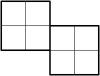
Take a 2x2 square, and join it to another 2x2 square, but only by half an edge. There's only one way to do that (ignoring reflections and rotations), shown below:


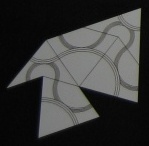
Now join on a third 2x2 square, again by only half an edge. This time, there are just four possibilities, all seen in the photograph below.

Back in 2002, my good friend Derrick Schneider noticed this nice little set of slightly strange shapes and wondered whether or not they'd make a good puzzle. He whipped up a little program to try packing the pieces into an 8x8 tray. To his delight (and later ours), there was just one way to fit in all four pieces! Many designers would have stopped there, but for some reason Derrick also tried running the program on a 7x9 rectangle: once again, incredibly, there was a unique solution!

Imagine the fun: he comes up with a simple way to define a set of pieces, the resulting set is nice and small, and that set fills both of the two most obvious tray shapes in unique ways. Believe me, such a mathematically elegant puzzle design doesn't come about every day! Add to that, the resulting puzzle falls into a real sweet spot of difficulty: harder than you might guess (those pieces are just plain tricky to get your brain around, especially the curled-up one), but easy enough to yield to a little patience.

Perhaps that explains why, when Derrick presented his puzzle at the 22nd annual International Puzzle Party, the jury for the Puzzle Design Competition awarded it an Honorable Mention, one of just three puzzles so honored.

Now, for the first time in many years, I'm happy to make Derrick's wonderful little puzzle available for sale again. Initially, I'll be selling off the remainder of Derrick's original manufacturing run; the last time I visited, I got him to dig around in the basement and pull out all of his old inventory for me. After that limited supply sells out (he could only find about 15 of them), I'll start making my own copies for you. This is simply too good a puzzle to remain unavailable for so long.

August 05, 2009

Anansi's Maze

As I write this, I'm helping to host the first Microsoft Non-Intern Puzzleday, a re-run of the puzzles from this year's regular Intern Puzzleday, just to give the actual Microsoft employees a whack at them. I'm sitting outside a room in which I've set up six "solving stations" for the multi-stage mechanical puzzle I contributed this year, Anansi's Maze. (The Intern Puzzleday actually has a budget, so I could afford to give each team a copy of the puzzle; for the non-interns, they have to timeshare.)

This year, I wanted to play with transparency, as you could probably guess from the picture. I started out with a much more complex puzzle idea, but whittled it down, stage by stage, to get something that was a more appropriate level of difficulty and that hung together more completely. The result, I think, is my best multi-stage puzzle yet, so I decided to also use it for my 2009 Exchange puzzle at the International Puzzle Party in San Francisco.

Anansi the Spider is the trickster spirit of Caribbean and Western African myth and legend, known for his creative mischief making. This puzzle will tease you with its ambiguities and lead you on a merry chase to find its hidden meaning.

Here is a maze, Anansi tells us, but there are no walls, no paths to follow, let alone any dead ends or cycles. Our treasured ‘right-hand rule’ is useless in these uncharted territories.

Anansi’s Maze is a multi-stage solving experience: finding the solution to one stage leads to a new puzzle, and that one to another! Where does this pathless path lead? Can you see through all of Anansi’s tricks and find the answer he’s left for you at the end of your journey?

Star Czech

Last year, my puzzle-design mind kept drifting to polyhedra, specifically to ways for pieces representing the faces of polyhedra to connect and interact with one another at each edge. My Octamaze and Gamesters of Triskelion puzzles came out of this realm, and for my IPP 2008 Exchange puzzle, I wanted to move up from the octahedron to my favorite of the Platonic solids, the dodecahedron. My experience with the tab-and-slot mechanism of the earlier puzzles, though, had made me very dubious that such an approach would continue to work for the rather larger dihedral angle of the dodecahedron: the tab would be coming into the slot at such a shallow angle that the slot would have to be quite wide, and the piece deformation needed to insert the last face probably wouldn't work at all, let alone elegantly.

I also wanted to use a prettier material than the opaque black high-impact polystyrene I'd used before, and that ruled out pretty much any piece deformation at all. (I'd tried making Octamaze out of acrylic, since it takes etching much better than polystyrene does, but after having my acrylic prototype shatter in my hands during disassembly, I gave up and went with the much more robust and pliant polystyrene.)

I decided that the pieces would rotate into position, using some kind of interlocking, hook-shaped protrusions on the edges of each face; that would still entail fairly wide (deep?) hooks, due to the shallow angle, but avoid any piece deformation during assembly. I realized that I might run into a mechanical problem with the corners of the faces hanging up on one another as each face was rotated into position, so I started considering various piece shapes that were missing the face corners. I started playing around with actual shapes on paper, instead of just thinking about all of it, and all of this came together in a kind of practical lesson in geometric duality: the hooks would be on the ends of arms, and the puzzle would look like stars with interacting points rather than the regular polygonal faces I'd originally imagined.

The final piece of the design came from my realization, late at night while trying to fall asleep, that there was a wonderful pun opportunity in naming the puzzle, since IPP last year was held in Prague. Once I'd come up with the name "Star Czech", and stifled my giggles to avoid waking up my wife, I knew I was done.

The resulting puzzle is probably the prettiest one I've ever designed, once assembled: it would make a great Christmas ornament, or an attractive object to dangle from the rear-view mirror of your car, let alone just sitting on your desk at work. It's also quite a difficult puzzle, so keep that in mind if you buy a copy. Like all of my puzzles, it comes with the solution, though, so nobody need know if you decide to short-circuit the solving and jump to the pretty bit.

Gamesters of Triskelion

My orignal plan, when designing the Octamaze puzzle, was that it would serve double duty, being both my gift to everyone at Gathering for Gardner 8 and something to torture the interns with at the 2008 Microsoft Intern Puzzleday. Sadly, though, it became quite clear during initial playtesting that Octamaze would be too difficult for the intern event. (I was willing to make the mathematicians, puzzlers, and magicians at G4G8 work harder...)

Still, I thought I could at least reuse the primary mechanical idea of Octamaze, and so I started from there when designing the Gamesters of Triskelion puzzle; I did, though, make that part a bit easier. The 2008 Puzzleday theme, for those of you who didn't recognize it immediately from the title, was Space, including many science-fiction references. I was put in mind of the Gamesters of Triskelion episode from the original Star Trek series by the triangular shape of the pieces from Octamaze, and somehow it occurred to me to check whether or not "triskelion" was actually a normal English word. As it happens, it is: a triskelion is a (sometimes quite literally) three-legged motif from heraldry and graphic design. I particularly liked some of the more modern interpretations of the motif, so I incorporated one into the etching on the pieces.

Gamesters of Triskelion is the third in my series of multi-stage puzzles, where solving one stage of the puzzle creates another puzzle for you to solve, on through some number of stages until you reach a single-word or short-phrase final answer. I'm having a lot of fun designing such puzzles, so you can expect the series to continue for quite a while.

Unlike most of my puzzles, this one comes with some "flavor text", not essential to solving the puzzle, but perhaps helpful:


Captain's log, stardate 3211.9: We are leaving starsystem M-24 Alpha, having convinced the three disembodied Providers, the one-time Gamesters of Triskelion, to help their former gladiators to form a new, free civilization. This should end the deadly gambling in their obsessively triangular fighting arena.

As we left orbit, the Providers transported a small octahedron onto the bridge, along with an engraved tablet (three sided, of course) in what appears to be their language. During transport, the faces of the octahedron detached from one another, so now we have eight triangular pieces.

Spock believes it will be straightforward to reassemble them since, he says, they can only fit together in one way. He is more puzzled about the meaning of the etchings on the faces, and how they might relate to the tablet, but assumes that this will become clear once the octahedron is back together.

May 04, 2008

Octamaze

Back in 1994, some folks decided it would be a cool idea to give a special 80th birthday present to Martin Gardner, long-time author of the very popular and significant Mathematical Games column in Scientific American magazine, as well as many books of mathematical puzzles and articles.

What better way to mark the occasion, they thought, than to bring together a lot of people who had enjoyed, and been influenced by, Martin's work? So they invited a bunch of people from the fields nearest to Martin's heart, from mathematics, puzzling, and stage magic, to come to Atlanta for the "Gathering for Gardner": several days of talks, performances, and exhibitions in celebration of Martin's 80th birthday. That first Gathering was such a huge success that the organizers decided to keep doing it and, every two years since then, there's been a Gathering.

I've known about the Gathering for some time now, through contacts at the International Puzzle Party, but I was pleased to be invited for the first time this year, for "Gathering for Gardner 8", or "G4G8". Similar to the Puzzle Exchange every year at IPP, the organizers of the Gathering ask that everyone provide a gift of some sort for all of the other participants. Many people fulfill this obligation by giving a talk and writing up a short article for the conference proceedings book, but many others bring puzzles, magic tricks, or other entertaining objects.

You know, of course, what I did, right?

Every Gathering for Gardner has a theme; I think you may be able to guess what all of the previous themes were when I tell you that this year's was "8, or the crazy lazy 8 (infinity)". I wanted to bring a new puzzle design that would strongly incorporate the theme, of course, but I also wanted to continue down the path I'd forged with my Ooo Tray puzzle last year. I wanted to design another multi-stage puzzle, with each solving stage revealing clues to the next stage, culminating in a "final answer" that was somehow satisfying.

I'd been idly thinking about three-dimensional edge-matching puzzles for a while (What? Don't try to tell me you don't think about such things, too.), and I'd wondered if it would work to make a polyhedron where the sides fit together with tabs and slots. With a theme like "8", this was a perfect (some might say Platonic) opportunity!

A little software work and many design iterations later, Octamaze was born. There are at least four stages in solving this puzzle, providing a good hour or two of "play time". If you buy a copy of Octamaze and get stuck, I've created a sequence of web pages giving a progression of hints for solving it. (Don't worry: clicking on that link won't immediately reveal any spoilers. If you keep clicking on the links at the bottom of each page, though, you'll eventually see all of Octamaze's secrets, so be careful.)

September 02, 2007

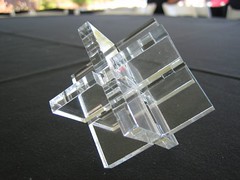
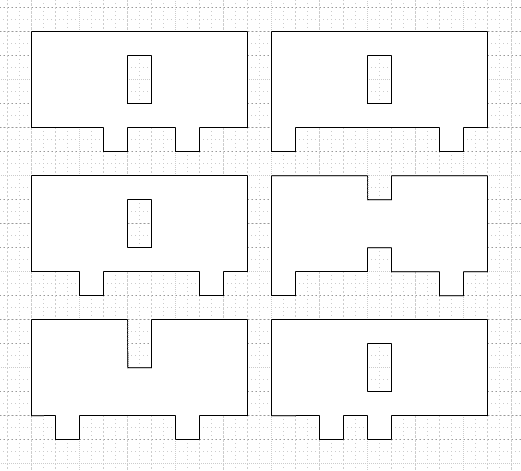
Six Tabbed Planks

I originally blogged about this puzzle a couple of years ago, shortly after I got my first copy of it, six years in the making. A few days after that, I got email from my friend George Miller, telling me that he'd laser-cut his own copy and liked it a lot. He showed that copy to long-time IPP attendee Stan Isaacs, who asked me for permission to use it in the IPP 26 Exchange, in Boston. At the time, I had a different puzzle in mind for my own exchange gift, so I agreed. Unfortunately, that other idea fell through (sometimes that happens with puzzle designs), so I ended up not exchanging that year. Instead, I was Stan's exchange assistant, which was fun in its own way.

The version that Stan exchanged was somewhat different from my original copy: he and George reshaped the pieces from rectangles to half circles, making the completed puzzle into a sphere instead of a cube; they called it the "Fan-Way Park Ball", following the Bostonian theme. They also used laser-cut maple instead of plastic and reduced the size to about 1-5/8 inches. It was cute in its own way, and I was happy to see the puzzle exchanged, but I still preferred the clear Lucite look of my original version; it looks a bit more stylish sitting on your desk.

I'm now happy to announce that I can offer copies of my version for sale here. The puzzle is shipped disassembled, flat, and putting it together provides a very satisfying but accessible solving experience.


August 17, 2007

The Ooo Tray

Every year, a group of volunteers puts on a one-day puzzle event for Microsoft's summer interns here on the Redmond campus called Intern Puzzleday. It's kind of a scaled-down version of the more well-known (and ambitious) Microsoft Puzzlehunt events. Although Puzzlehunt traditionally begins at about 10am on Saturday and continues straight through to dinner time on Sunday, Intern Puzzleday is a kinder, gentler one-day affair, almost exactly 24 hours shorter than Puzzlehunt.

This year, I had the great fun of joining the team of volunteers putting on Puzzleday 2007, and I designed or co-designed five different puzzles for the event, three of which we finally used on the day itself. Perhaps I'll write a fuller description of the event later, but for now I'll just show one of the puzzles I designed for it.

Traditionally, Puzzlehunt and Puzzleday puzzles are designed to have a short, one- or two-word answer that solvers can type into email or a web page to prove that they've finished. All of those answers are later used in one or more layers of "meta-puzzles" leading eventually to a final "hunt" somewhere on campus for an artifact specific to that hunt's theme.

I wanted to find some way to incorporate a mechanical puzzle into this domain that's typically dominated by paper-and-pencil or on-site-event puzzles. To do so, I started with the tray and piece design from my "Perkinson Guest Bathroom Tile" puzzle and laser-engraved some additional information on both. The result is, I think, something new in the world of mechanical puzzles: a puzzle with an answer, not just a solution. In this case, the answer is just four letters long, and finding it takes you through a multi-layer solving experience; guidance for the first layer is etched right onto the tray ("Place all twelve pieces flat in the tray"), and solving each layer reveals more guidance on how to attack the next one. There are a total of three or four layers to this seemingly simple puzzle, depending on how you count. During Puzzleday, the Ooo Tray was solved by all 28 teams of interns, and it was the first puzzle that many teams worked on.

Update:
I'm now making this puzzle in beautiful natural cherry! I've also tightened up the design slightly from the original to give the puzzle a somewhat more nicer look and an even more satisfying ending.


Easter Island Dominoes

Flush with the successful design of the "Perkinson Guest Bathroom Tile" puzzle, the obvious next step was to consider dominoes instead of trominoes. This time, I allowed the pieces to be flipped over, and I also counted pieces whose two tiles had their tilted edges at right angles to each other. This leads to a complete set with 13 members, some of which are slightly strange looking, and one of which (with the two tilted edges joined together) is a quite boring perfect rectangle.

Leaving out the boring rectangle, we get twelve roughly one-by-two-unit dominoes; the obvious tray shape is a six-by-four-unit rectangle. Can the (nearly) complete set fill that tray? Sadly, my packing program said no, and this time it also didn't work to change the top and bottom edges into the angular "sine wave" pattern from the bathroom-tile puzzle. I had my local laser cutter, Joe Pelonio, make me up a set of the pieces anyway, so that I could play with them and try to get a feeling about why the rectangular tiling wouldn't work. The first thing I noticed when I got the pieces in my hands was that one of them looked a lot like the profile of one of the famous "moai" heads from Easter Island; thus the eventual name of the puzzle.

When I presented Easter Island Dominoes at the 2007 IPP Exchange in Australia, I told the following story:

It's not well known (especially to archaeologists), but many, many sets of these 12 pieces have been discovered in excavations on Easter Island. Never, though, have they come across a copy of that elusive 13th piece, the perfect rectangle. From this, we can infer that the ancient Easter Island culture, now long lost to us, did not approve of straight lines and perfect rectangles. Being a culturally sensitive fellow, I've created a tray that has one tilted tile edge exposed on each edge of the tray, thereby avoiding violating the islanders' taboos.

Your first challenge in solving this puzzle is simply to lay all twelve pieces flat in the tray; there are 250 ways to do that, and it's not very difficult if you just have a bit of patience. You'll find, though, that almost every such packing has at least one blemish (as least from the point of view of ancient Easter Island culture): there will either be (a) a straight-line crack all the way across or down the puzzle, or (b) a subset of the pieces that form a perfect rectangle or square, or (c) both!

There are just 83 ways to pack the pieces without a straight-line crack, and only six ways to do so without forming a perfect square or rectangle. Your real challenge is to find one of merely three solutions that have neither "blemish". That'll take you a little bit longer to achieve, I think.

The "Perkinson Guest Bathroom Tile" Puzzle

A week before Thanksgiving, 2006, Kathleen and I drove down to Portland for the weekend, to see some dear friends who'd driven up that far from the Bay Area, and to attend a games party being thrown in their honor (or at least using them as an excuse) by Dave and Diane Perkinson. Dave and Diane are consummate hosts, and they'd invited us to stay in the guest room of their wonderful Craftsman-style house. The bathroom adjoining the guest room still has the great original tile, consisting of squares that have had one of their edges tilted, half one way and half the other. The tiles are laid in straight rows with the tilt of the edges alternating back and forth across the floor, making a kind of angular sine-wave pattern.

At some point as I was sitting in the bathroom, contemplating the world around me, I started to wonder how many ways there were to select three adjacent tiles from the floor in an L shape. (Now, their floor had the sine-wave lines from one row out of phase with those from the next row, but I allowed for both in-phase and out-of-phase patterns in my wondering.) Assuming that, like the real tiles, you couldn't flip a piece over to get its mirror image, I was pleased to discover that there are exactly twelve possibilities. Twelve pieces, times 3 tiles per piece, makes 36, a perfect square. This therefore led immediately to the question of whether or not a complete set of the pieces could be assembled to fill a six-by-six square. I resolved to find out as soon as I returned home, using my packing-puzzle design program.

Once I'd enhanced the software to support pieces that can't be flipped over, I was saddened to discover that the perfect six-by-six square is not, in fact, solvable. Happily, though, a complete set of pieces will nicely fill a variant of the square that has in-phase sine-wave lines at top and bottom. There are two distinct solutions, plus their mirror images. The "Perkinson Guest Bathroom Tile" puzzle is non-trivial to solve, but not wildly difficult either.


Sleazier

In the fall of 2004, I was playing around with a deceptively simple little tray puzzle designed by Stewart Coffin and called Four Sleazy Pieces. The eponymous pieces are polyominoes with between five and seven squares each, and the tray is a perfect square whose size is not an integral number of units; it's about 5.8 units on a side. I won't spoil Coffin's fine puzzle here, but suffice to say that, at the time, I hadn't solved it very recently so I'd temporarily forgotten just how "sleazy" the solution is.

While failing to solve it, I stumbled across an interesting property of such a puzzle, and I was excited to note that what I'd found was probably a good psychological "blind spot". These blind spots usually take the form of an assumption most people make that's so "obvious" that it's never questioned, even though it isn't in fact true. Armed with such a blind spot, you can often create a puzzle to exploit it, a puzzle whose solution violates that implicit assumption. That kind of a puzzle has a very pleasant "ah-ha" feeling to it; once you've solved it, you can't figure out how it could possibly have taken you so long.

My resulting puzzle, Sleazier, has that property, and I'm inordinately pleased with it: I think that it's probably the best puzzle I've yet designed. I presented it in the 2005 IPP Exchange, in Helsinki, and it's gotten great feedback in the years since then.

Like Coffin's puzzle, Sleazier has four polyomino pieces ranging from five to seven squares each, and a square tray of a suspiciously odd size; your goal is simply to fit all four pieces flat in the tray. I won't say why, here, but when you compare the "trick" of my puzzle to that of Coffin's, mine definitely deserves its name.


The Devil's Half Doven

In my very first IPP Exchange, in 2000, I presented a puzzle designed by Bill Darrah, called Raft 5. It consisted of 10 sticks, each with a dovetail notch cut across it and a matching dovetail tab glued on along it. There were five different positions on the stick where a notch or tab could be located, for a total of 10 different pieces, and the puzzle contained one of each. Somewhat surprisingly, it's actually possible to assemble these 10 pieces in a raft-like arrangement, with five sticks going one way laid across five going at a right angle.

Raft 5 is a good puzzle, and for the 2003 Exchange in Chicago, I decided to take inspiration from it. The raft is essentially two dimensional, and I wanted to somehow extend the idea into 3-D. To keep the number of possible pieces down, I made my sticks shorter, with only three positions where a notch or tab could be placed, but I also made the sticks square in cross-section (as opposed to rectangular, as in the raft). This allowed tabs and notches to appear on different sides of the stick, even at right angles to one another.

If you leave out the cases where a notch and tab appear in the same position along the stick (unless they're on opposite sides of the stick), then you get a total of 14 possible pieces. That seemed like too many for a good puzzle, so I picked just half of them; I was perversely tickled by the idea of using seven pieces in an interlocking puzzle, instead of the traditional six. Of course, seven pieces can't make a very symmetric shape, but I made a virtue of that, and designed the puzzle so that the final shape isn't particularly important. Instead, the goal is simply to arrange the pieces so that every piece's tab is inserted into some other piece's notch; that forms the pieces into a kind of folded-up loop, each inserted into the next, like a snake eating its own tail.

There are four solutions to the puzzle, two of which have the fun property that the resulting assembly will balance nicely on the end of one of the sticks. Those two solutions look a bit like a figure standing on one foot, which I like quite a lot; at some point, I want to make a very large set of the pieces to use as a bit of artwork for our yard.


The Grand Vizier: A Penrose tiling puzzle

Grand Vizier piece

For the 2002 puzzle party in Antwerp, I wanted to design something that would lead people to explore the strange world of Penrose's non-periodic kite-and-dart tiles. Some years earlier, someone else had already exchanged a Penrose-based puzzle; that one was just a set of kites and darts that had been distorted a bit to resemble two kinds of birds (and to enforce the normal edge-matching rules). The goal had been simply to fit them together to make the classic regular decagon that crops up every you look in any tiling.

For my own puzzle, I wanted to challenge you to do more than simply learn how to tile the pieces; I wanted it to be a real puzzle. I played around with a Penrose tiling applet for a while and came up with an outline that looked, to me anyway, a lot like the head of a man wearing a turban. That shape required 76 tiles to make, so I broke it up into a set of 16 multi-tile pieces, each containing between 3 and 5 tiles. I then laser cut and etched those pieces with Conway's beautiful curves that show where the legal edge matches are. The resulting puzzle has a unique solution and is fairly difficult.

To make it a bit easier, I added a little removable panel that reveals where some of the tile boundaries are (and that shows why I thought the shape looked like a Grand Vizier). I also included in the package a "little bit bigger hint" that shows where all of the tile boundaries are (but not the piece boundaries, of course).

Finally, I discovered that a subset of pieces I'd chosen could be assembled to form that same classic decagon I mentioned above, so I made the puzzle tray two sided, with the outline of the Grand Vizier on the front and the outline of the decagon on the back. Oddly enough, even though I don't tell you which subset of the pieces you have to use in filling the decagon tray, that side is definitely easier than the front.


August 10, 2007

Hinomaru: The Japanese Flag Puzzle

In 2001, the 21st annual International Puzzle Party was held in Tokyo, and I decided to honor the hosts with a puzzle based on the simple, elegant design of the Japanese flag, also known as Hinomaru (literally, "the circle of the sun"). To start, I drew the flag's design on a 6-by-4 rectangle and then broke it up into twelve 1-by-2 dominoes. Then, to make things tricky, I also colored the backs of all of the dominoes in ways that make them look like potential fronts. Thus, all of the dominoes are double-sided, and it's not at all obvious which side is the front! Add to this the high degree of symmetry in the flag design, which makes the piece placements even more ambiguous, and you have a very difficult puzzle.

(At the 2007 IPP in Australia, six years later, someone came up to me during the Exchange and said, "I spent a long, long time solving that flag puzzle of yours." He then handed me his Exchange puzzle. "This," he said, "is my revenge!" Needless to say, I haven't solved his puzzle yet...)

The Hinomaru puzzle has a unique solution (up to swapping pieces with the same face-up design), and that solution leaves only the front face looking like the flag; the backs of the pieces look entirely random when solved (no helpful hints there!).

I also have an all-paper version of the puzzle, consisting just of the 12 double-sided cards that are sandwiched inside clear acrylic in the version above. This version doesn't come with a tray, just the cards wrapped up in a simple origami envelope.


Pavel's Pipe Dream

When I was invited to my first International Puzzle Party in 1999, in London, I learned that I would not be allowed to participate in that year's Puzzle Exchange event. There's a very good rule that you need to have attended IPP once before you do the Exchange, to give you a chance to soak up a bit of the party's culture and quality expectations. I decided, though, that I would produce some kind of puzzle anyway, so that I could try to trade it informally for Exchange puzzles (and others).

The only problem was that I had never designed a puzzle before! I mentioned this issue to my friend Barry Hayes and his response was both surprising and surprisingly helpful: "There are puzzles all around us! Almost everything you see is a puzzle; the only tricky part is to recognize how."

As it happened, I was in the local home center the next weekend, buying parts for our garden sprinkler system. Surrounded by all these very uniform pipes and fittings, Barry's words came back to me and I decided that there must be lots of puzzles hidden in these bins. The first thing that came to mind, of course, was a puzzle involving water moving through the pipes, but it didn't take me long to reject that idea in favor of something, anything, less complicated, less "analog". But what else would neatly fill a pipe? Well, anything round would, like ball bearings and dowels...

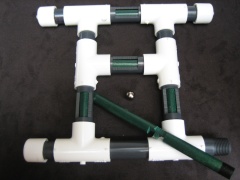
Pavel's Pipe Dream

The result, Pavel's Pipe Dream, is shown at right. There are five dowels, one starting inside each pipe, with notches on the dowels intersecting (and therefore interacting) inside each T fitting. The ball bearing starts just inside the (sealed) endcap in the lower left corner. To solve the puzzle, you must manipulate the dowels through the little windows in the pipes to eventually free the ball. I brought more than 50 copies of the puzzle to London, and succeeded in trading all of them (and the promise of another dozen or so more) to various of the attendees. I came back home after the party drunk with the fact that I'd added something like 65 new puzzles to my collection!

I don't have any more assembled copies of this puzzle left, but I've got lots of copies of the various bits and pieces lying around in the shop. It's not my favorite of my designs, but perhaps if there's sufficient demand I'll produce one more run of them for sale. Leave a comment if you might be interested.

August 23, 2005

My new puzzle

My new puzzle

After collecting some 90 new puzzles in the IPP 25 puzzle exchange, and maybe another dozen at the puzzle party the next day, you'd think I'd be pretty well saturated with puzzles to play with, and that's true. So what makes this one (additional) new puzzle so cool? Well, there's a story behind that.

Six years ago, I attended my first ever International Puzzle Party, at a hotel near Heathrow Airport in London. (How I finally found out about, and got invited to, IPP is another story.) One of the several great organized excursions that year was a trip to the country manor home of Edward Hordern, who at the time had one of the two or three largest puzzle collections in the world. (Sadly, Edward died less than a year later. Now, the annual puzzle exchange is named in his honor.)

Edward's home, Cane End, was very large and he'd arranged for a huge tent to be set up in the "front yard" to house the tables for lunch and other activities. On each table, there were a few items from his vast collection of something like 25,000 puzzles. A copy of the puzzle shown in the picture, made from water-jet-cut Baltic birch plywood, was one of those. Given the materials and workmanship, it was probably from one of the Finnish contingent.

I couldn't solve it in the brief time I had with it there, so I jotted down the design on the back of a deposit slip from my checkbook, and it sat like that in my wallet for six years. A few months ago, I finally got around to transferring the design into Visio, in preparation for getting it laser cut by my local neighborhood sign maker, but never actually got it done.

Last weekend, at Foo Camp, the folks from Squid Labs had brought both a cutter and some 1/4" Lucite, and they announced Saturday night that they'd be cutting or etching whatever people wanted. I had my laptop with me, and the design was all ready to go, so how could I resist? It was pretty cool watching it do the cutting, seeing a sheet of plastic turn into an interesting puzzle in just a few minutes. Very cool.

The puzzle design

I don't know who originally designed this puzzle. If, by chance, you do, please let me know so I can thank them myself. Happily, it turns out to be quite a nice little puzzle.

In case you're interested, my copy of the design appears to the left. The smallest feature size should be equal to the thickness of the material you're using. In my case, it's 1/4" of an inch, which was the thickest acrylic the Squid Labs folks had at the time. For those of you with Microsoft Visio, here's the original design file.

Update on 8/31: More copies of the design file, in DXF format and DWG format. You're welcome, Andy.

Shopping Cart